(Lexington Books, 2014)

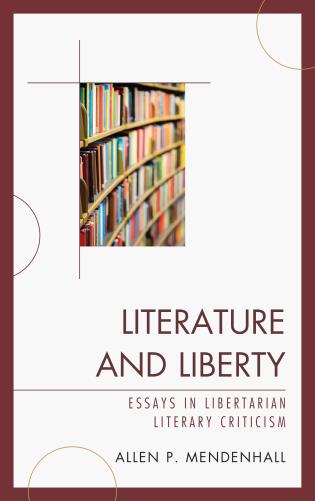
By subtitling his book “Essays in Libertarian Literary Criticism,” Allen Mendenhall situates his work within an exciting methodological approach that is still off the radar screens of most academicians. Not since the appearance of Edward Said’s Orientalism has a new literary approach invited us to read texts from a vantage point that jolts us into recognition of deep-seated ideological undercurrents that had previously remained unnoticed, or were simply passed over in silence. … It is a pleasure to now add Mendenhall’s deftly argued and passionately engaged volume to my list of recommended readings in libertarian scholarship.— Jo Ann Cavallo, Professor of Italian and Director of Undergraduate Studies, Columbia University
The much celebrated interdisciplinarity of contemporary criticism often amounts to nothing more than the absence of grounding in any traditional intellectual discipline, literary or otherwise. By contrast, Allen Mendenhall’s book is genuinely interdisciplinary. With solid credentials in law, economics, and literature, he moves seamlessly and productively among the fields. Covering a wide range of topics—from medieval history to postcolonial studies—Mendenhall opens up fresh perspectives on long-debated critical issues and raises new questions of his own.— Paul A. Cantor, Clifton Waller Barrett Professor of English, University of Virginia
Freedom is all around us, but we sometimes need expert guides to help us see it. This is exactly what the brilliant Allen Mendenhall has done with his outstanding collection of essays on the way great literary fiction interacts with the themes of human liberty. In taking this approach, he is turning certain academic conventions on their heads, finding individualism and property rights where others look for social forces and collectivist imperatives. He helps us to have a rich and deeper appreciation of the libertarian tradition and its expanse beyond economics and politics.— Jeffrey Tucker, CEO of Liberty.me, Distinguished Fellow at the Foundation for Economic Education, executive editor of Laissez-Faire Books, and Research Fellow at the Acton Institute
In Literature and Liberty, Allen Mendenhall aims to expand the marketplace of ideas in literary studies to include the entire spectrum of free-market theories. His goal is to break Marxism’s monopolistic hold over economic ideas in the study of imaginative literature. In his diverse chapters, he convincingly offers multiple transdisciplinary approaches to libertarian theory that literature scholars could adopt and build upon. Celebrating individualism and freedom in place of collectivism and determinism, Mendenhall focuses on commonalities and areas of agreement with respect to free-market theories. This approach increases the probability that the ideas in this ground-breaking volume will be widely embraced by thinkers from various schools of pro-capitalist thought, including, but not limited to Classical Liberalism, the Austrian School, the Judeo-Christian perspective, the Public Choice School, the Chicago School, the Human Flourishing School, and Objectivism.— Edward W. Younkins, Professor of Accountancy and Business Administration and Executive Director of the Institute for the Study of Capitalism and Morality, Wheeling Jesuit University
Allen Mendenhall is both an attorney and an advanced student of literature. He also has an excellent knowledge of modern economics. … [A]s Mendenhall notes, non-Marxist treatments of economics and literature have been slow to develop. His new book, Literature and Liberty, goes far toward supplying this lack. It shows how much work can be done, and good work too, when law and literature are studied from the perspectives offered by a real competence in economic ideas. … Every part of the book shows the fully interdisciplinary character of Mendenhall’s understanding of his subjects and his large knowledge of the historical periods he treats. Only the rare reader will be unable to learn from Mendenhall. … The kind of interdisciplinary work that Mendenhall advocates is an exciting enterprise, and one hopes that he will have much more to do with it.— Stephen Cox, Professor of Literature, University of California, San Diego, and Editor in Chief, Liberty
Allen Mendenhall’s Literature and Liberty is clearly aimed at a … scholarly audience. … [T]he fact that Mendenhall is writing about law and literature from a libertarian perspective is one of the strengths of the work. Most libertarian literary scholars are likely to think of doing literary analysis from a free market perspective as a corrective to the pervasive Marxism within the academy, but we certainly shouldn’t forget that libertarianism is a theory of governance, meaning that we libertarians have to understand something about the law. Mendenhall corrects this tendency with his book. … Mendenhall’s book is recommended precisely because he engages in libertarian literary criticism, showing the value added in doing so. Moreover, he primarily analyzes texts through the lens of law (not surprising given he is a lawyer), making his contribution to literary studies unique. Law and literature is perhaps more common than is libertarian literary criticism, but Mendenhall’s combination of the two is precisely what makes his book worth reading.— Troy Camplin, The Journal of Ayn Rand Studies
Allen Mendenhall presents libertarianism as an alternative lens through which to view works of literature as a means of understanding them better. … The economist Thomas Sowell has written that much of the academic work that calls itself “interdisciplinary” is in fact non-disciplinary when it fails to require the actual mastery of multiple disciplines. Fortunately, Mendenhall’s work is not vulnerable to this critique. As the holder of both a Ph.D. in English (this book was published when he was a doctoral candidate) and a law degree, Mendenhall is well qualified to write on the intersection of literature, political theory, and law. … [H]is true interdisciplinary background allows him to critique literary studies from both the inside and the outside. … Literature and Liberty is a thought-provoking work that provides new looks at a number of classic texts from a perspective that is, quite frankly, refreshing given the current climate of literary criticism.— Jason Jewell, Department of Humanities, Faulkner University
“A new book by Allen Mendenhall … seeks to expand the work done by [Paul] Cantor and others in developing a new approach to criticism. … [N]umerous applications of libertarian critical theory are found in Mendenhall’s book.”— Matthew McCaffrey, University of Manchester
Reviewed here in Libertarian Papers (republished here at LewRockwell.com [PDF] and here at Mises Daily [PDF] and translated into Spanish here and here as “Pioneros en la crítica literaria de libre mercando” by the Instituto Mises Hispano); here in The Quarterly Journal of Austrian Economics [PDF]; here in The Journal of Prices and Markets [PDF]; here in The Independent Review [PDF]; and here and here in The Journal of Ayn Rand Studies [PDF]; and here in Journal of Faith and the Academy (republished here at Mises Wire [PDF] and translated into Spanish here and here as “El antidoto para la crítica literaria marxista” by the Instituto Mises Hispano); discussed here at Mises Wire [PDF]. Audio: Listen to Robert Hale narrate Dr. Jo Ann Cavallo’s review by clicking here.
Other praise for scholarly work:
[B]ehind the stories we love to tell are the more insistent stories that are the real driving forces of a nation that was structured around the system of slavery. These are stories that resist a neat outline or a clean telling, and more often than not they are stories marked by a revealing incoherence. Allen Mendenhall explores one of the most important examples of those subterranean tales, a Supreme Court case that led to a devastatingly simple conclusion—the denial of African American rights to citizenship—but a conclusion that follows from an incoherent mess of conflicting and partial stories, more than 500 books that together add up to a haunting presence in American legal, political, and cultural history. … Mendenhall does important work in uncovering the history surrounding and obscuring the Dred Scott decision. He reminds us that legal decisions are often the product of complex, competing, and sometimes nearly incomprehensible stories, and he demonstrates that we can learn a great deal about U.S. racial history by studying the stories told to bolster legal decisions informed by prejudice. The twisted and competing tales he discovers behind the scenes and in the aftermath of Dred Scott are revealing, but they would not be terribly surprising to African Americans of the time, who understood well both the foreground and the implications of the decision.— John Ernest, Chair and Judge Hugh M. Morris Professor of English, University of Delaware
Allen Mendenhall offers a compelling analysis of the Dred Scott decision, positing Chief Justice Roger B. Taney’s initial opinion as a deathblow to Scott’s humanity that released a haint, which would haunt all future references to the case. It is appropriate, then, that Mendenhall cites Toni Morrison’s Beloved, a novel that imagines the return of history through the body of a child dealt a deathblow by her mother’s own hand. Consistent with Mendenhall’s interest in recorporealization, the baby that Sethe kills returns to the present in bodily form and this has various interpretations.— Michelle S. Hite, Professor of English, Spelman College
Mendenhall has focused our attention on the serious misconception that lawyers can teach writing skills. No doubt many a young associate can testify to a supervisor’s writing or editorial ineptness. It doesn’t bear much repeating that most lawyers are not inclined to treat the English language with kindness. And even good writers may not have the time or temperament to teach others how to write. (It’s easier to rewrite the darn thing themselves.) … Mendenhall is on to something. The legal profession could make much better use of those who teach writing for a living and those who would like to.— Jeffrey Shulman, Professor of Legal Research and Writing, Georgetown University Law Center